



Blog Salt room
Salt Room in Bușteni: Halotherapy at Forest Retreat Villas
Respiratory wellness · Bușteni · Bucegi Mountains

Sometimes the body isn’t asking for more. It’s asking for less. Less noise, fewer notifications, less rushing. It asks only for a few minutes in which the one thing that matters is the way you breathe.
What is halotherapy?
Halotherapy is a respiratory wellness practice that involves breathing the air of a salt room, a space in which fine salt particles are dispersed into the air. Its aim is to recreate the clean, calm microclimate of natural salt caves in a controlled, comfortable setting. It is regarded as a complementary relaxation therapy, not a medical treatment.
The benefits in brief: relaxation and stress relief, freer breathing through the nose, possible support for allergies and mild asthma, a child-friendly environment and a wellness ritual for adults.
There is a feeling most of us have forgotten: a deep, easy breath that reaches effortlessly to the very top of the lungs. We feel it rarely – perhaps on a mountain summit, perhaps by the sea, on those mornings when the air seems clean in a different way. The Forest Retreat salt room was designed for exactly those minutes. A warm space, softly lit by walls of Himalayan salt, where the air has a different texture and where, for the first time in a long while, you can simply do nothing.
This guide is our site’s reference article on halotherapy – the starting point for all our other pieces on wellness, families, allergies and mountain holidays. We wrote it hoping that a respiratory specialist would find it balanced, a parent would find it useful, and a future guest would feel it was worth saving and sharing. Here you will find everything that matters: what a salt room really is, how a halogenerator works, what the research says, the real benefits by group, the contraindications and, at the end, a bibliography of verifiable medical sources.
When we created the Forest Retreat salt room, we didn’t just want one more facility for our guests. We wanted a place where people could slow down, breathe and enjoy a few moments of genuine quiet.
Many of our guests choose to start or end their day here, and for children it is often one of their favourite places in the whole complex. Perhaps that is what we love most: a space designed for breathing has become, without us forcing anything, the place where families spend time together.

What exactly is halotherapy?
Halotherapy (from the Greek halos – salt) means exposure, in a salt room, to air charged with fine salt particles. In its active form, a device called a halogenerator turns salt into microscopic particles that you breathe in; in its passive form, the saline environment is created by salt walls and surfaces. Both aim for the same thing: a clean, peaceful saline microclimate.
The practice has old roots. As early as the 19th century, doctors noticed that miners in salt mines had, surprisingly, better respiratory health than the general population. That observation gave rise to speleotherapy – spending time in salt caves and mines – and later to modern halotherapy, which brings the same principles into a comfortable above-ground space, accessible all year round.
The difference between the types of salt room is not a technical detail; it defines, honestly, what you actually get. That is why we put together the table below – a clear reference for anyone trying to understand what each option really means.
Halotherapy is exposure to saline air in a specially designed room. It can be active (with a halogenerator, which micronises the salt) or passive (with salt walls). It is a complementary wellness therapy, not a medical treatment.
Natural salt cave, Himalayan salt room and halogenerator
There are three main approaches to salt therapy. Each plays a different role, and understanding them helps you compare the offers you come across fairly:
| Feature | Natural salt cave (cave / salt mine) | Himalayan salt room (passive) | Halogenerator (active halotherapy) |
|---|---|---|---|
| Environment | Natural underground microclimate | Himalayan salt walls and blocks | Room with a dry salt aerosol dispersed mechanically |
| How the salt gets into the air | Naturally, through the cave air | Hygroscopicity and minimal evaporation | Micronised particles of 1-5 microns, actively generated |
| Main mechanism | Prolonged exposure to saline air | Atmosphere, relaxation, low humidity | Inhaling fine particles that reach the airways |
| Sensory experience | Cool, damp, underground | Warm, amber light | Warm, with active saline air you can just about sense |
| Accessibility | Limited (requires a trip to a salt mine) | High, indoors | High, indoors, available all year round |
| Closeness to clinical studies | Speleotherapy, studied (e.g. Cochrane) | Focused on wellness and relaxation | Closest to the studies on saline aerosol |
| At Forest Retreat | – | YES (Himalayan walls) | YES (halogenerator) |
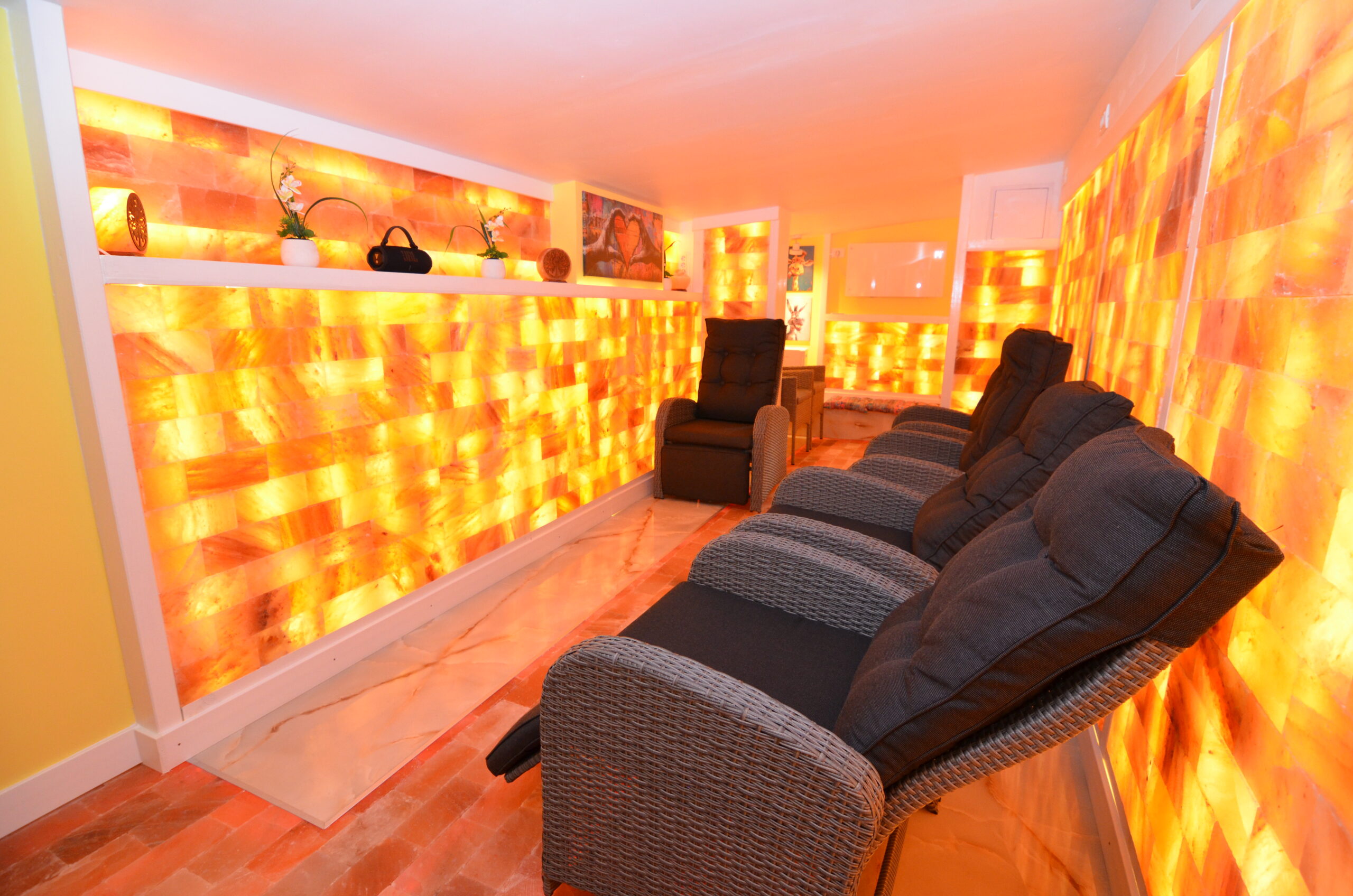
The value of this distinction is that it clears up a common confusion: not every space with a few salt bricks on the wall also offers an active mechanism. The Forest Retreat salt room brings together both useful columns of the table – the warm atmosphere of Himalayan salt and the active aerosol of the halogenerator.
A natural salt cave means caves and salt mines; a Himalayan salt room offers mainly atmosphere and relaxation; a halogenerator actively disperses fine salt particles, the form closest to the clinical studies. Forest Retreat combines the last two.
How does the Forest Retreat salt room work?
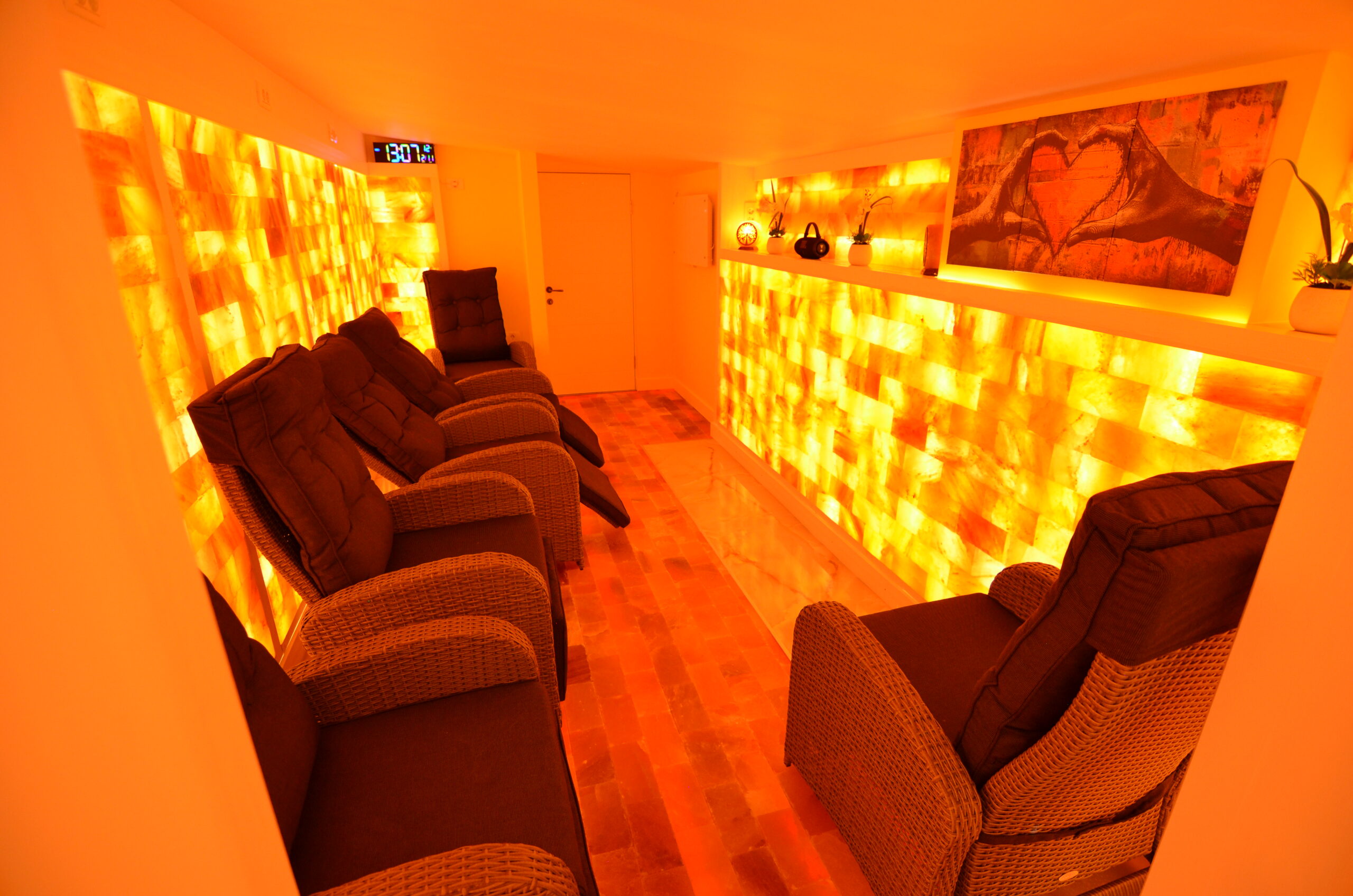
When you step into the Forest Retreat salt room, the first thing that changes you is not the air but the light. The walls of Himalayan salt blocks filter the lamps into a warm amber glow, almost like a sunset caught in the wall. This translucent colour is the signature of Himalayan salt, mined from geological layers hundreds of millions of years old. But the visual beauty is only half the story. The other half works quietly in the background.
The halogenerator – the active heart of the salt room
Unlike a simple room with salt walls, our salt room uses a halogenerator. It takes dry, pharmaceutical-grade salt and grinds it into microscopic particles, in the order of 1-5 microns, which it disperses into the air as a dry saline aerosol. The size of these particles matters enormously: because they are so small, they don’t stay in the throat but can be carried by the breath deeper into the airways. This is the essential difference between sitting next to a salt wall and actually doing halotherapy.
In practice, the environment works through four elements that complement one another:
- The salt aerosol generated by the halogenerator, the active component, inhaled naturally as you breathe calmly.
- The Himalayan salt on the walls, which creates a low-humidity environment and a feeling of clean air; salt is hygroscopic, meaning it attracts and holds moisture.
- The warm, diffused light passing through the salt crystals, which slows the pace and relaxes the eyes – and with them, the whole body.
- The quiet – no phones, no screens, just discreet ambient sound and reclining armchairs in which the body can let go completely.
You don’t do anything in the salt room. The salt room does it for you. You sit down, let your weight sink into the chair, close your eyes and let your breathing slow. For many of our guests, it is the first time in weeks that the body has been given explicit permission not to be responsible for anything.
Why Himalayan salt matters
Beyond sodium chloride, Himalayan salt contains trace minerals that give it its pinkish-amber colour. In a salt room it is valued for its stability and for its unmistakable visual atmosphere – a combination of warmth, calm and a sense of natural space that is hard to reproduce with other materials. Together with the halogenerator, it turns the room into a complete saline microclimate.
The Forest Retreat salt room works through the combination of a halogenerator, which disperses 1-5 micron salt particles into the air, and Himalayan salt walls, which create the atmosphere and low humidity. The result is an active saline microclimate, not merely a decorative one.
What is a session in the Forest Retreat salt room like?
You don’t need any special preparation and you don’t have to do anything complicated. A halotherapy session is, essentially, time for yourself. Here is what it looks like, step by step:

- You go in wearing clean socks and comfortable clothes, leaving your phone aside.
- You sit down in an armchair and let your body rest its full weight.
- You breathe normally. No special techniques are needed – the saline air does the work for you.
- You relax, eyes closed, in the warm light of the salt walls.
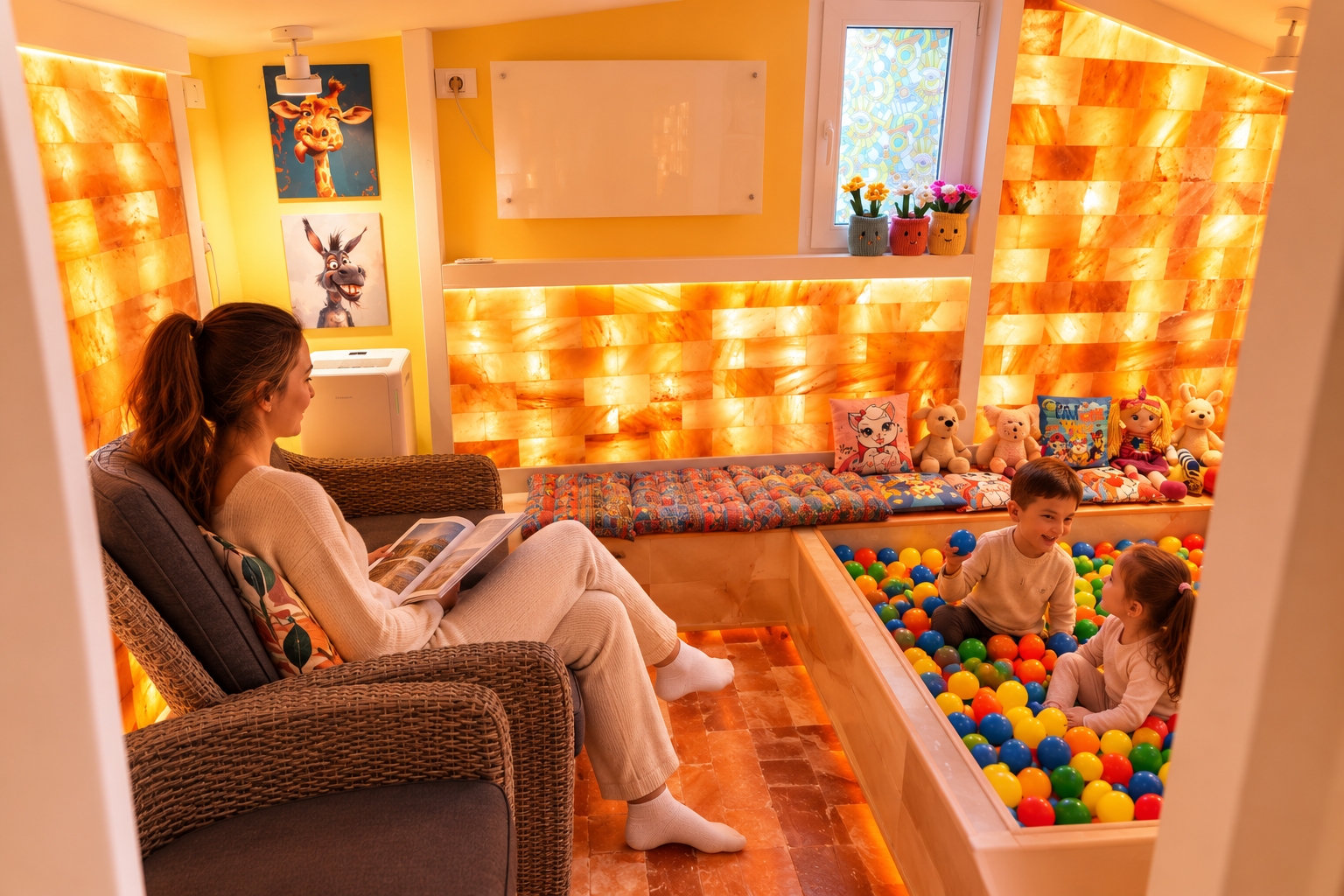
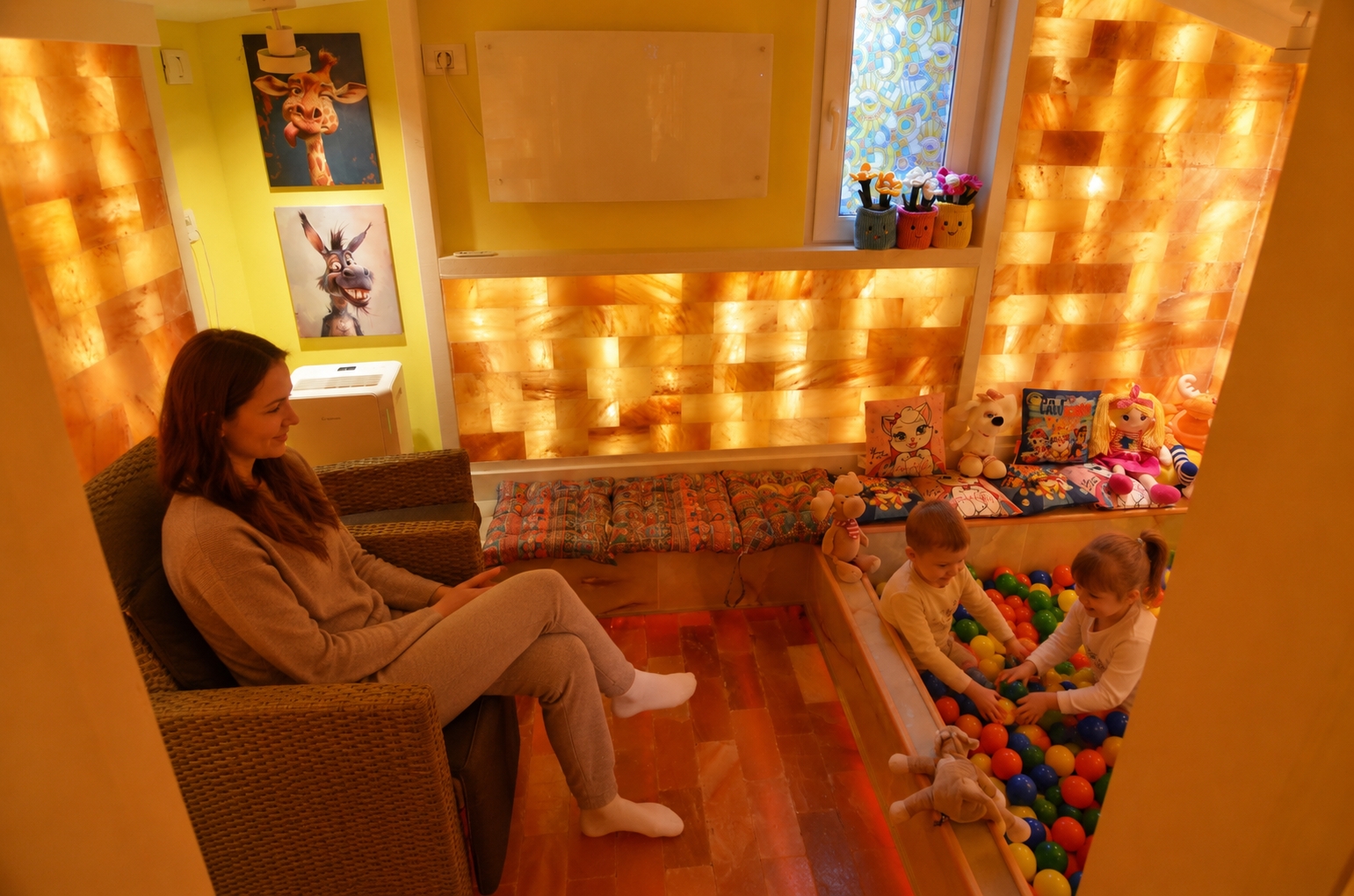
- The children play quietly in their ball-pit area, in the same saline microclimate.
- At the end you drink some water and leave feeling as if you have pressed pause for a few minutes.
That’s it. There is no effort and no rush. Your only task is to breathe normally and let the quiet carry you.
A session is simple: you go in, sit in an armchair, breathe normally and relax in the warm light of the salt while the children play in their area. At the end you drink a glass of water. No preparation is needed.
The benefits of halotherapy, by group
This is where accuracy is essential. Halotherapy is a field in which enthusiasm sometimes outruns the evidence, and a serious article must clearly separate three categories of benefit. We will use this convention throughout the section:
- demonstrated supported by clinical studies, even if limited in number or quality;
- possible mechanically plausible and suggested by preliminary research, but not firmly confirmed;
- reported frequently described by users, subjective, without solid clinical validation.
| Effect | Level of evidence | Notes |
|---|---|---|
| Relaxation, stress relief | reported | The most consistent effect; down to the setting, the light and the quiet. |
| Freer breathing through the nose | possible | Suggested by small studies on respiratory conditions. |
| Help with clearing mucus | possible | Hypothetical mucolytic effect, limited evidence. |
| Relief of some symptoms of mild asthma | demonstrated | Existing clinical studies, of variable quality. |
| Respiratory anti-inflammatory effect | possible | Suggested, among others, by animal studies. |
| Silkier-feeling skin | reported | Described by users; little clinical evidence. |
For children
Children catch colds often. It is part of being a child – their immune system is learning. For parents, though, the endless round of blocked noses and seasonal coughs can be exhausting. A few studies possible suggest that a saline environment might support a better bronchial response in children with mild asthma, and freer breathing through the nose. We are not talking about a treatment, but about gentle, complementary support alongside the care recommended by your paediatrician.
The big practical advantage for families is something else: children don’t see their time in the salt room as a medical chore. At Forest Retreat, their area has a colourful ball pit, soft cushions and toys, so the little ones play happily in the same saline microclimate in which their parents can, at last, breathe too. It is one of the few spaces where adult relaxation and children’s good mood happen at the same time – one more reason we are delighted to welcome families with children (in Romanian) to our three villas.
Beyond any benefit, children love the salt room simply because it is theirs. The warm, amber light seems straight out of a fairy tale. They have a colourful ball pit, soft toys and room to move around freely. There are no screens, no “sit still”, no rush – just play, in clean, warm air. And for a parent, that is exactly the picture they want from a holiday: their child laughing a few steps away, safe, while they finally get to breathe.

For children, halotherapy is considered safe and, for those with mild asthma, possibly useful as complementary support. The practical advantage is that the little ones play happily while their parents rest at the same time. For existing conditions, a paediatric consultation is still necessary.
For adults
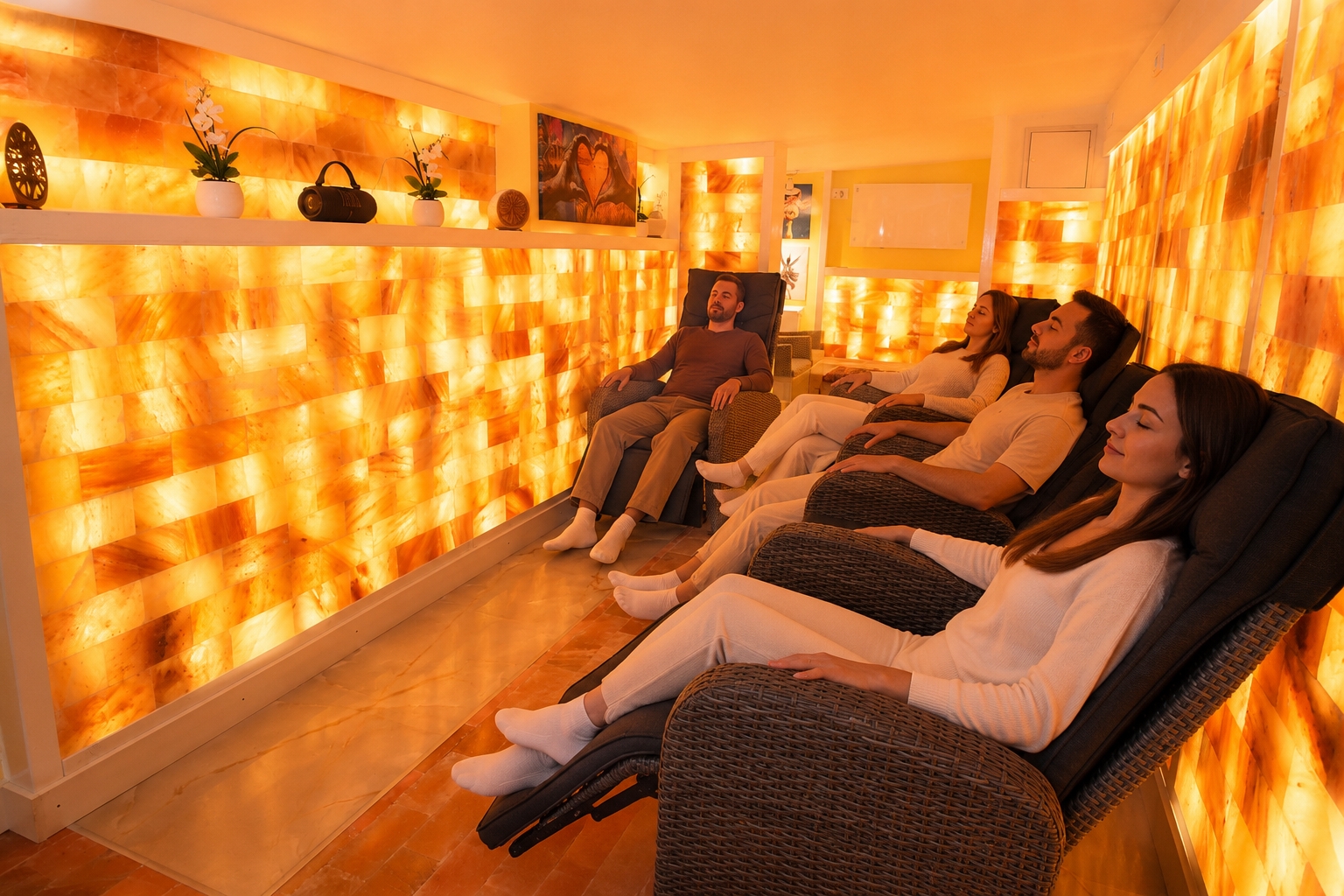
For an adult caught between meetings, deadlines and decisions, the most immediate benefit is reported consistently: a real drop in inner tension. Not because salt has some miraculous effect, but because the whole setting – saline air, warm light, quiet, a resting position, slow breathing – creates the conditions in which the nervous system switches from “alert” mode to “recovery” mode.
For breathing, adults exposed every day to polluted city air, air conditioning or allergy seasons possible may notice clearer breathing after a course of sessions. And for those who simply want a respiratory wellness ritual, the salt room offers exactly what is most often missing from a modern holiday: a legitimate reason to stay still.
For adults, the most reliable benefit is deep relaxation and lower stress. Possibly, a course of sessions may bring a feeling of clearer breathing, especially for those exposed to city air or seasonal allergens.
For couples and older guests
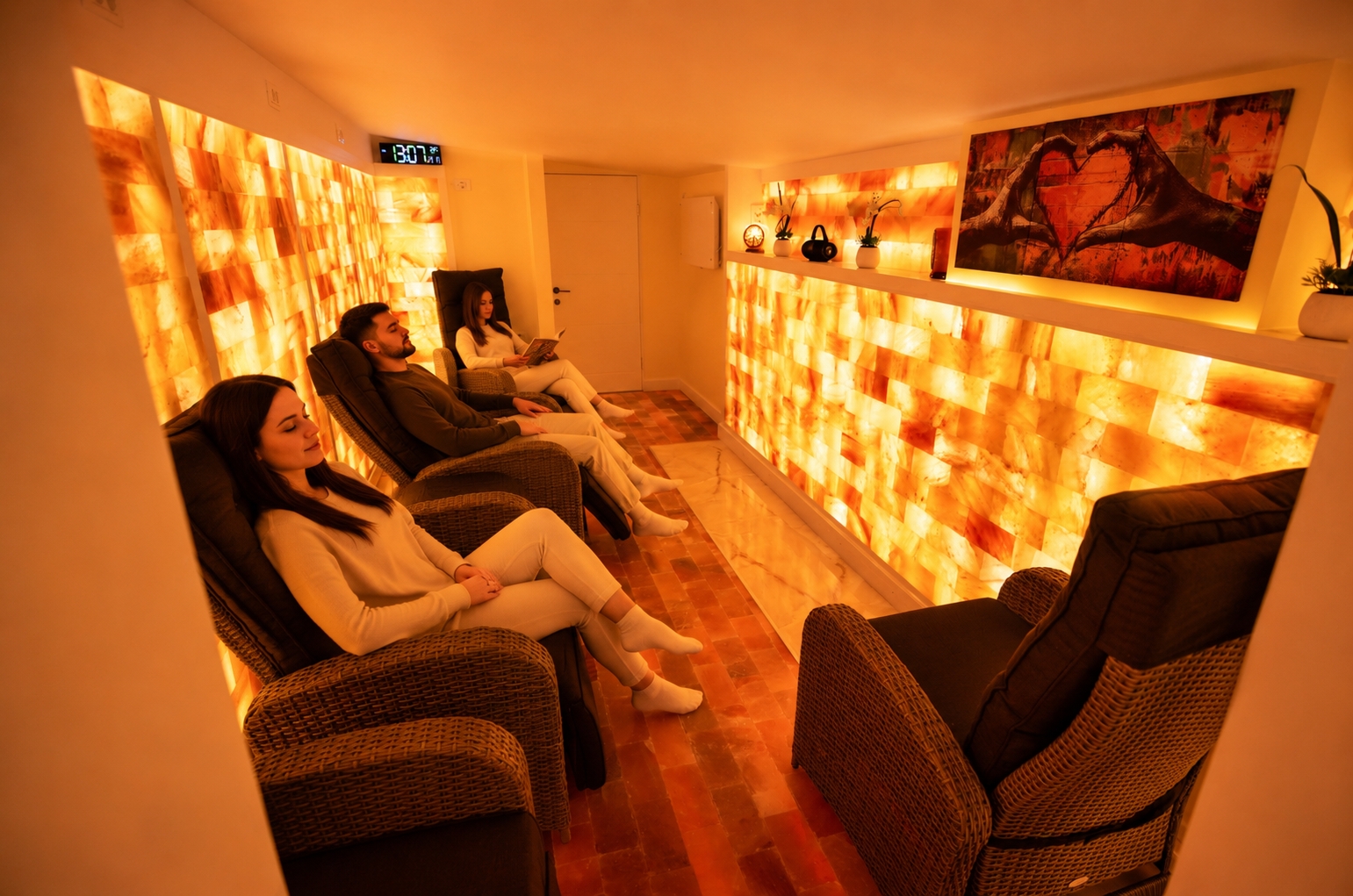
For couples, the salt room has a particular value, less about the lungs and more about being present. It is one of the few places where two people can sit side by side with no screen, no tasks, nothing to sort out – the kind of shared quiet from which the best conversations are actually born. Or silences. On a romantic weekend in the mountains, this may be the most unexpected part of the stay.
For older guests, the warm, effortless environment of the salt room is appealing precisely because it asks nothing physical of them. There is no intensity and no risk of overexertion. It is a gentle, accessible form of recovery that suits a calm pace – with the proviso, true at any age, that people with chronic conditions should talk to their doctor beforehand.
For couples, the salt room offers a rare space for being present without screens. For older guests, it is a gentle form of relaxation with no physical effort. In both cases, chronic conditions call for medical advice beforehand.
For smokers, athletes and respiratory recovery
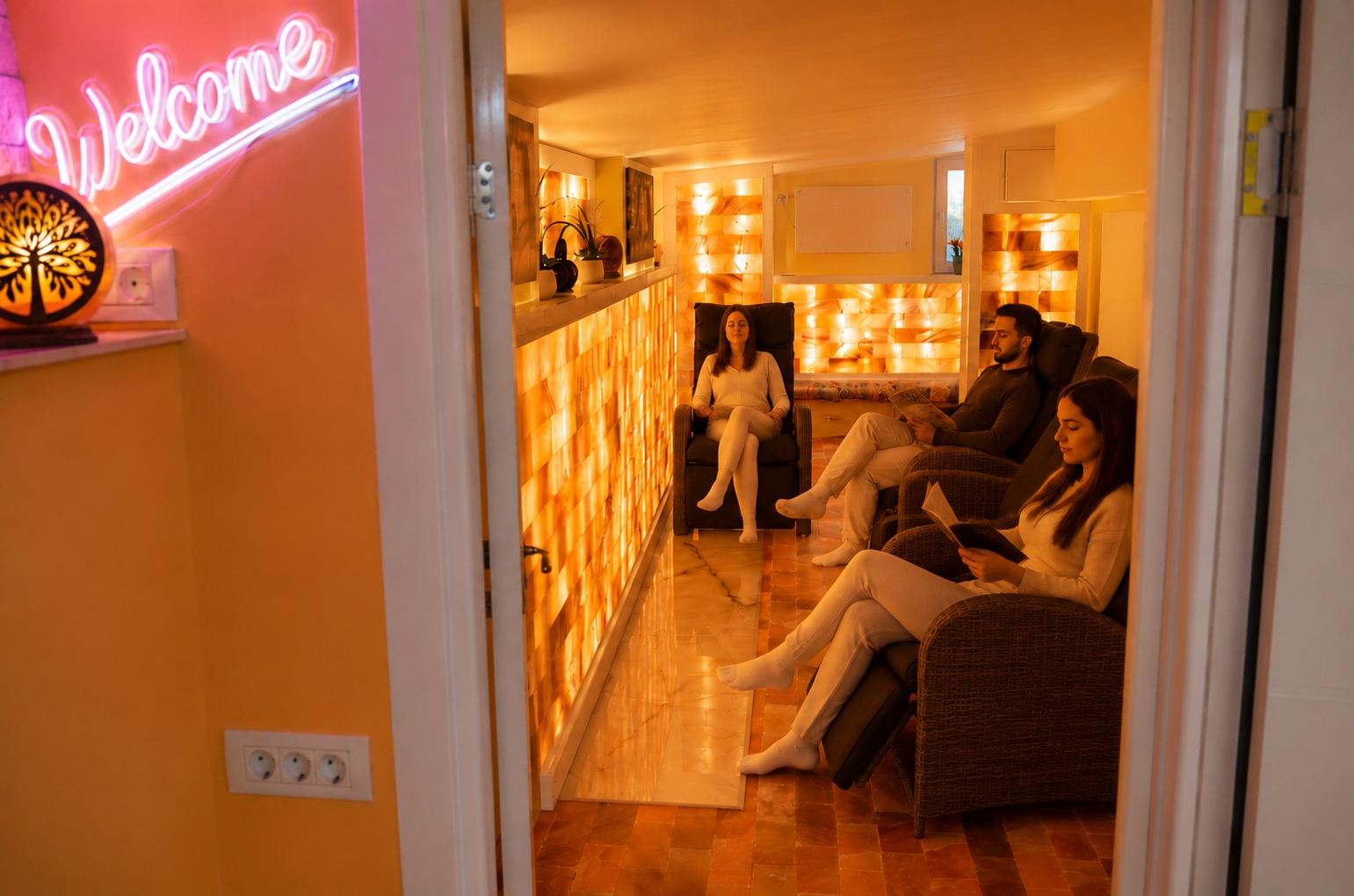
For smokers and former smokers: over time, smoking affects the lining of the airways and the lungs’ natural cleansing mechanisms. A saline environment is reported as pleasant and, subjectively, “freeing” for the breath, especially while quitting. It must be said clearly: halotherapy does not cleanse the lungs of the effects of smoking and is not a detox method. It can, however, be an enjoyable part of a lifestyle in which breathing becomes a priority again.
For athletes: performance depends on good respiratory capacity and efficient recovery. A calm environment with saline air is valued reported as part of a recovery routine, alongside sleep and hydration. Specific performance benefits remain possible plausible but not firmly demonstrated.
For people with allergies: respiratory allergies mean irritated, inflamed nasal passages. A clean, dry saline microclimate possible may contribute to a feeling of decongestion and freer breathing through the nose. It does not, however, replace the treatment recommended by your allergist.
For people with asthma: asthma is the condition most studied in connection with halotherapy. There are studies that demonstrated show improvements in some symptoms in mild forms and improved bronchial tolerance. The quality of the studies varies, and the medical community consistently calls for more rigorous research. The golden rule: halotherapy can be a complement, never a replacement for medication. People with uncontrolled asthma should avoid saline environments until their condition is stable.
For respiratory recovery: after a lingering cold, bronchitis or a spell of polluted air, many people instinctively look for “fresh air”. A saline environment offers reported exactly that feeling of freshness and possible may support the natural clearing of secretions – provided the acute phase (fever, active infection) has passed.
Halotherapy can be pleasant complementary support for smokers, athletes, people with allergies or mild asthma, and for respiratory recovery. The best-documented effect is on mild asthma; the rest remains, largely, at the level of possible or reported benefit.
What does scientific research say about halotherapy?
This is the section very few websites offer honestly – and that is exactly why it matters for your trust. We give a balanced summary of what the specialist literature shows at present, without exaggerating and without playing anything down. All sources are listed at the end of the article.
What the studies show
Most research has focused on respiratory conditions: asthma, chronic bronchitis and chronic obstructive pulmonary disease (COPD). Some studies have reported positive effects – a better bronchial response in children with asthma, signs of anti-inflammatory activity in patients with chronic bronchial conditions, and improvements in lung function and quality of life. A randomised study published in 2020 looked at speleotherapy for allergies and asthma, with encouraging results for symptoms.
The limits of the evidence
Honesty is needed here. A broad 2014 review published in the International Journal of COPD examined the literature on halotherapy in COPD and concluded that the evidence is, overall, inconclusive: most studies had methodological weaknesses, and only one good-quality randomised clinical trial met the strict inclusion criteria. Similarly, a Cochrane review of speleotherapy for asthma found that no firm conclusions can be drawn because of the small number of solid studies. Recent reviews acknowledge possible benefits but almost unanimously stress the need for larger, better-controlled randomised trials.
The proposed mechanisms
In theory, inhaled fine salt particles could have mild antibacterial properties, could help clear mucus (a mucolytic effect) and could reduce inflammation in the airways. These mechanisms are plausible, but they remain largely hypotheses awaiting solid clinical confirmation.
The balanced conclusion
Halotherapy has a good safety profile for most people and relaxation benefits that most users feel straight away. Medically, the evidence for respiratory conditions is promising but still insufficient for firm claims. That is why our position is simple and honest: see the Forest Retreat salt room as a wellness and respiratory relaxation experience, not as a treatment. For any medical problem, your doctor remains the first authority.
Research suggests possible benefits of halotherapy for asthma and other respiratory conditions, but the evidence remains limited in number and quality. It is a complementary therapy that is safe for most people, not a substitute for medical treatment.
What is NOT allowed in the salt room?
A salt room works best as a shared, calm and clean space. A few simple rules protect everyone’s experience and the integrity of the salt walls, which are sensitive to moisture and knocks:
- No food or drink – crumbs and liquids affect the saline environment and the salt surfaces.
- No smoking of any kind, including e-cigarettes.
- No loud talking and no phones with the sound on – the quiet is part of the therapy.
- No running and no boisterous games that disturb other guests.
- No touching or damaging the salt walls – don’t lean on them or scratch the surfaces.
- No pets in the salt room.
- No outdoor shoes – clean socks are worn instead.
- No strong perfume before a session, to keep the air neutral.
In the salt room there is no eating, no smoking, no loud talking, no running and no touching the salt walls. You go in wearing clean socks, without strong perfume and without pets. These are simple rules that keep the microclimate clean for everyone.
How long is a session recommended to last?
| Aspect | General recommendation |
|---|---|
| Length of a session | about 20-45 minutes |
| Frequency | 1-2 sessions a week, in courses of 6-10 sessions |
| Can you do it every day? | yes, for relaxation; it isn’t necessary – your own comfort is what matters |
| Ideal time | whenever you can be completely relaxed, often in the evening |
A few practical tips that make a difference: dress comfortably and loosely, ideally in light-coloured clothes; wear clean socks; take off any jewellery that could be affected by the salt; drink water before and after; and, perhaps most importantly, put your phone away. A salt room session isn’t measured in minutes, but in how completely you manage to stop rushing.
A session lasts 20-45 minutes, ideally in courses of 6-10 sessions, with 1-2 a week. Wear comfortable clothes and clean socks, stay hydrated and put your phone away.
Who should ask a doctor’s advice first?
Halotherapy is considered safe for most people, including children. Even so, as with any wellness practice, there are situations in which a word with a doctor beforehand is the wisest choice. We recommend seeking medical advice before a session in the following cases:
- acute respiratory infections (pneumonia, acute bronchitis) or active tuberculosis;
- fever or any acute illness in its active phase;
- uncontrolled asthma or severe symptoms not managed by medication;
- advanced, severe COPD;
- uncontrolled high blood pressure;
- uncontrolled thyroid conditions or unstable hormonal imbalances;
- active eye infections (for example, conjunctivitis);
- open wounds or active skin infections;
- a known allergy or hypersensitivity to salt;
- pregnancy – a conversation with your doctor beforehand is recommended.
We don’t say this to alarm anyone, but out of respect for each person’s body. For the vast majority of our guests, the salt room is simply a pleasant place to relax. And if you have a chronic condition, your doctor is best placed to confirm that you can enjoy the experience fully and safely.
Medical advice is needed before halotherapy for: people with acute infections, fever, active tuberculosis, uncontrolled asthma, severe COPD, uncontrolled high blood pressure or thyroid conditions, eye or skin infections, salt allergy, and pregnant women.
The Forest Retreat salt room – an experience, not just a room
We could describe the salt room through its features: Himalayan salt walls, a halogenerator, reclining armchairs, warm lighting, a dedicated children’s area. But that would miss the point. The Forest Retreat salt room is not a room. It is a stretch of time.
It is the moment on the second day of your stay when your body, finally unwound by the mountain air and a good night’s sleep, comes down here and settles. It is the hour when the children play among the colourful balls and you realise that, for the first time in ages, you don’t have to watch them anxiously. It is the silence between two people who no longer feel the need to fill it.
The salt room is one of the facilities included for guests of the Forest Retreat complex, alongside our other wellness experiences. It isn’t something you have to look for outside your stay – it is right there, a few steps away, part of the same story of reconnecting that brought you to the mountains. At 900 metres above sea level, in Bușteni, beneath the ridges of the Bucegi Mountains, the air alone is reason enough to come. The salt room adds another dimension to that air: a space where, for a few minutes, breathing becomes the only thing that matters. Discover all our Bușteni accommodation (in Romanian) options at Forest Retreat.
You can enjoy the salt room during a stay at any of our three villas – Vila BRUNO, Vila ELENA or Vila IRIS – each with its own personality, but all part of the same premium experience. It is the natural complement to the other moments of relaxation, from the heated pool and hot tub to the quiet of the forest at the edge of the property. And if you are planning an event or a special occasion, you can find out more in our events and parties section or directly from our reception.
The Forest Retreat salt room is a facility included for guests of the complex, available during a stay at any of the three villas. It combines active halotherapy with a premium atmosphere, at 900 m altitude, in Bușteni.
Frequently asked questions about halotherapy and the Forest Retreat salt room
What is halotherapy?
Halotherapy is a respiratory wellness practice that involves breathing, in a salt room, air charged with fine salt particles. It recreates the clean, calm microclimate of salt caves in a controlled setting. It is a complementary therapy, not a medical treatment.
How does a salt room with Himalayan salt and a halogenerator work?
The halogenerator grinds pharmaceutical-grade salt into particles of 1-5 microns and disperses them into the air, while the Himalayan salt walls create a warm, low-humidity environment. Together they form an active saline microclimate that you breathe in during the session.
What is the difference between a passive salt room and one with a halogenerator?
A passive salt room relies only on salt walls and offers mainly atmosphere and relaxation. One with a halogenerator adds an active mechanism that disperses fine salt particles into the air – the form closest to the clinical studies on saline aerosol. The Forest Retreat salt room combines both.
How long should you spend in a salt room?
A session usually lasts between 20 and 45 minutes. For a more consistent wellness effect, courses of 6-10 sessions are recommended, at a frequency of 1-2 a week.
What are the benefits of halotherapy?
The most consistently reported benefit is relaxation and stress relief. For breathing, limited studies suggest possible decongestant effects, help with clearing mucus and relief of some symptoms of mild asthma.
Is halotherapy recommended for children?
Yes, it is generally considered safe for children and they often enjoy it, especially in a space with a play area. For children with chronic respiratory conditions, it is advisable to consult a paediatrician beforehand.
Is it beneficial for adults?
Yes. For adults, the main benefit felt straight away is deep relaxation, and for breathing it may bring a feeling of clearer breathing after a course of sessions.
Does it help with allergies?
Possibly. A clean, dry saline microclimate may contribute to a feeling of nasal decongestion, but it does not replace the treatment recommended by your allergist and does not cure allergies.
Does it help with asthma?
Asthma is the most studied condition, and some studies show symptom improvements in mild forms. Halotherapy can be a complement, never a replacement for medication, and people with uncontrolled asthma should avoid it until their condition is stable.
Does it help smokers?
Many smokers describe the saline environment as pleasant to breathe in, especially while quitting. It must be said clearly: halotherapy does not cleanse the lungs of the effects of smoking and is not a detox method.
Are there contraindications?
Yes. Avoiding it, or seeking medical advice first, is recommended in cases of acute respiratory infections, fever, active tuberculosis, uncontrolled asthma, uncontrolled high blood pressure, uncontrolled thyroid conditions, eye or skin infections and salt allergy.
Who should NOT have halotherapy?
People with an acute illness in its active phase (fever, infection), active tuberculosis, severe uncontrolled asthma or other unstable chronic conditions should avoid the salt room until they have clarified the situation with their doctor.
Can you do it every day?
Yes, for relaxation a daily session is not a problem for most people. It is not necessary, though; what matters is your own comfort and, for chronic conditions, your doctor’s advice.
Is it safe for children?
Generally, yes. Halotherapy has a good safety profile and children usually tolerate it very well. For existing respiratory conditions, it is advisable to consult a paediatrician first.
What should you wear in a salt room?
Comfortable, loose clothing, preferably light-coloured, and clean socks. It is best to remove any jewellery that could be affected by the salt and to avoid strong perfumes.
What is not allowed in a salt room?
No eating, no smoking, no loud talking, no running, no touching or damaging the salt walls, and no animals.
Does halotherapy replace medical treatment?
No. It is a complementary wellness and relaxation experience, not a substitute for medical advice or prescribed therapy. For any health problem, your doctor remains the first authority.
Will I feel an effect straight away or after several sessions?
The relaxing effect is usually immediate. Any possible respiratory benefits are associated more with courses of repeated sessions than with a single visit.
How long does it take for the effects of halotherapy to appear?
It varies from person to person. Some guests notice a feeling of easier breathing or relaxation after the very first sessions, while for others continuity is what matters most. For respiratory conditions, what counts is your doctor’s advice and regularity, not quick promises.
Is halotherapy suitable for a romantic weekend?
Yes. The salt room is one of the most pleasant spaces for a couple: quiet, warm light and not a single screen – the natural complement to a premium stay devoted to reconnecting.
Why Himalayan salt in particular?
Himalayan salt is valued for its stability and its unmistakable visual atmosphere – a warm, amber light that creates a sense of natural space and calm, hard to reproduce with other materials.
Do I need to book the salt room at Forest Retreat?
The salt room is a facility included for guests of the complex. For details on access and availability during your stay, our reception will be happy to give you all the information.

Forest Retreat, the place where you truly rest
Sometimes the best part of a holiday is the part where you do nothing. You just sit. You breathe. You let your thoughts slow down. And if, years from now, you remember Forest Retreat as the place where you finally managed to rest properly, then we will have achieved what we set out to do.
Sources and bibliography
We have used only credible, verifiable sources. The information on effectiveness and the limits of the evidence in this article is based on:
- Rashleigh R, Smith SM, Roberts NJ. A review of halotherapy for chronic obstructive pulmonary disease. International Journal of Chronic Obstructive Pulmonary Disease. 2014;9:239-246. doi:10.2147/COPD.S57511. Full text
- Beamon S, Falkenbach A, Fainburg G, Linde K. Speleotherapy for asthma. Cochrane Database of Systematic Reviews. 2001;(2):CD001741. PMID: 11406004. Cochrane Library
- Halotherapy – An Ancient Natural Ally in the Management of Asthma: A Comprehensive Review. Healthcare (Basel). 2021;9(11):1604. doi:10.3390/healthcare9111604. PubMed
- Freidl J, Huber D, et al. Winter Exercise and Speleotherapy for Allergy and Asthma: A Randomized Controlled Clinical Trial. Journal of Clinical Medicine. 2020;9(10):3311. doi:10.3390/jcm9103311. Full text
- Global Wellness Institute. Wellness Evidence: Halotherapy / Salt Therapy. globalwellnessinstitute.org
- World Health Organization (WHO). Asthma – Fact sheet. who.int
Note: the information in this article is for educational purposes and does not constitute medical advice. For diagnosis and treatment, please consult a doctor.